Galileo Cruises the Inner Jovian System
Galileo atraviesa el sistema joviano interno
玩家
0
評分
4.5★
遊戲分類
Astronomy
關於
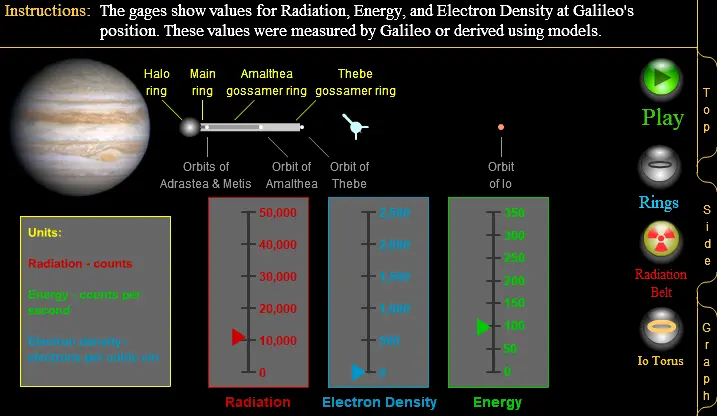
The animation below shows some of the information Galileo gathered on the November 2002 encounter (known to Galileo mission team members as the the "A34 pass"). You will need to have the latest version of the Flash player to see this animation. There is more information about the features shown in the animation further down this page. The animation shows the area close to Jupiter. Jupiter has 79 moons; the five closest to the planet (Adrastea, Metis, Amalthea, Thebe, and Io) are shown here. Jupiter also has a series of rings, like the famous rings of Saturn. Jupiter's rings are much fainter and smaller than are Saturn's. Saturn's rings are mostly ice, while Jupiter's are made of dust. Jupiter has three major rings. The Main Ring is very narrow and thin. The Halo Ring is closer to Jupiter than the Main Ring, and is a larger, diffuse cloud of particles. Outside the Main Ring is the wispy Gossamer Ring. It has two parts: Thebe Gossamer Ring (further out) and the Amalthea Gossamer Ring (closer in). Data from Galileo led scientists to discover the source of the ring material! The material in the rings is fine dust hurled up from the surfaces of Jupiter's inner moons by meteor impacts. Although it is nearly invisible, the dust of Jupiter's rings fills much of the space near the giant planet. There are other, even less visible, features near Jupiter that Galileo's instruments helped us detect. The space near Jupiter is seething with powerful magnetic fields, intense storms of radiation, and swarms of energetic particles. There are three types of data shown in the animation: radiation, energy, and electron density. The radiation values represent the general background radiation levels, and are expressed in units of counts. This type of radiation is caused by bombardment by electrons. The energy values are measurements from an instrument designed to register counts per second of sulfur ions in a certain energy range. Sulfur from Io's atmosphere "leaks out" into the space around Jupiter. The sulfur in Io's atmosphere comes from eruptions of Io's many volcanoes. Scientists are uncertain whether the instrument for measuring sulfur ion counts worked correctly. It may have been "swamped" by electrons, and given false readings. That instrument, called the Energetic Particle Detector, also measured counts of many other types of ions in various different energy ranges. The third value shown is electron density. It is expressed in terms of electrons per cubic centimeter. There are a lot of electrons zooming around the space near Jupiter!
創作者
Windows to the Universe
遊戲工作室
分類
Astronomy
類型
小遊戲
發佈日期
最近
玩家
0
Windows to the Universe 的更多作品
更多 Astronomy 遊戲
你可能也喜歡
其他玩家最近最愛玩的熱門遊戲。